Breaking In

Over 100 Advertising Insiders Reveal How to Build a Portfolio that Will Get You Hired

Interviews by William Burks Spencer

Get new posts via Twitter, Facebook, RSS, or Email

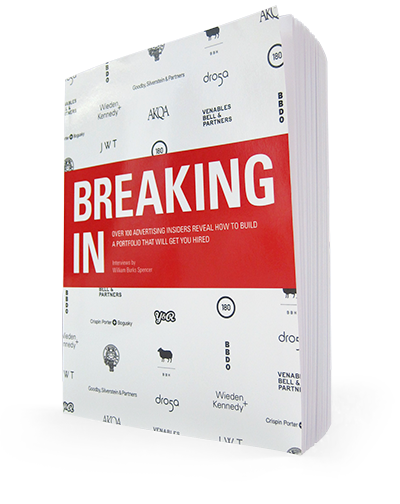
Breaking In's front cover

Interview Excerpt: Akash Das, Executive Creative Director, Lowe Lintas & Partners, Mumbai

Check out some great work from Akash Das.

WS: What do you look for in a student book? And what impresses you?

AD: Freshness. Freshness in terms of the projects they have done and also how they have compiled their book. I remember hiring two people onto my team…one just showed me some thought-through book covers and the other a scrapbook full of ideas. Newness in the idea is what I look for.

WS: How important is finish? If ideas are the most important thing, can sketches be enough? Do you look at physical books anymore or is it all websites?

AD: I believe skills can be learned over time, from your seniors and from people you admire in the business. As a newcomer, people should focus on ideas. And for the second part, I get to see both websites as well as physical books. But I feel a personal interaction is always better.

WS: How important is writing? Do you need to see long copy?

Continue reading

Read the full interview in BREAKING IN: Learn more about the book or Buy it on Amazon
Next Up: Akash Das

Akash Das is Executive Creative Director at Lowe Lintas & Partners in Mumbai..

HCL Technologies – The Employees First Effect

Publicis Perspective

Publicis Perspective

Continue reading

Read the full interview in BREAKING IN: Learn more about the book or Buy it on Amazon
Interview Excerpt: Greg Farley, Freelance Copywriter/Creative Director, New York

Check out some great work from Greg Farley.

WS: What do you look for in a student book? And what impresses you?

GF: Talent in the basics. Show me a writer that can write or an art director with a unique visual point of view and I’ll gladly work with you. I’d rather see a perfect print ad than a poorly written or designed social media idea. Being good at your specialty doesn’t make you a dinosaur.

WS: How important is finish? If ideas are the most important thing, can sketches be enough? Do you look at physical books anymore or is it all websites?

GF: Finish is a fact of life. These days there are stacks of near-professionally crafted books lining the offices of every recruiter. Take the time to make your book sing, but do it online. No one should be killing forests for advertising anymore.

Continue reading

Read the full interview in BREAKING IN: Learn more about the book or Buy it on Amazon

Next Up: Greg Farley

Greg Farley is a freelance Copywriter/Creative Director in New York.

Toyota

Continue reading

Read the full interview in BREAKING IN: Learn more about the book or Buy it on Amazon

Interview Excerpt: William Gelner, Executive Creative Director, 180 Los Angeles

Check out some great work from William Gelner.

WS: What do you look for in a student book? And what impresses you?

WG: Fast ideas. You’d be surprised at how many books have slow ideas. Intricate flow charts, multiple steps, a confusing and tiring journey. Yes, I want ideas that are whole and 360-degrees. But tell it simply. That said, the other issue that I see with books is the flip side of that: a lot of books coming out of school that are all visual solutions. That’s really tricky when you’re trying to hire a writer. Maybe it shows that they can think visually and can distill things down, but what about when you need an idea that is simple, well written, and to the point? You’d be surprised at how many writer books don’t have good, concise writing in them. Just verbal diarrhea. That says “lazy” to me. I don’t like lazy.

WS: That was actually one of my follow-up questions: do you think long copy is necessary? And, you sort of answered that, so let me ask it this way: do you think writers need to demonstrate writing in ads, or could it be in something else?

WG: I think it could be something else, as long as it’s not 30 pages. I don’t want to—again, we’re looking for people who can write well. That means simple, concise, insightful. We are in the digital age. And digital takes many forms. It’s not just websites. It’s more about content and conversation. And content needs to be articulated somehow. It can be mobile, for example. Or it can be on-demand content, or it could be television shows, or whatever.

Continue reading

Read the full interview in BREAKING IN: Learn more about the book or Buy it on Amazon

Next Up: William Gelner

William Gelner is Executive Creative Director at 180 Los Angeles.

Axe – Gamekillers Case Study

Sony – The Rocket Project

Continue reading

Read the full interview in BREAKING IN: Learn more about the book or Buy it on Amazon

Interview Excerpt: Dany Lennon, President, The Creative Register, Westport

WS: What do you look for in a student book? And what impresses you?

DL: First of all, I am a “website” person, not a “book” person. Some people are still romantic about books. I am not. I like a site because not only do “ideas” have to come across clearly, concisely, and profoundly to transmit through that medium—as it is less tactile and emotional—but it really does ultimately become extremely poignant and engaging if the ideas are strong and, of course, that is the most important thing. Some may argue that the tactility of a hard portfolio cannot be beaten, but the fact is, we must understand and accept that the digital page is the current focus and the future. The publishing world is equally substantiating that as they go full-speed online. It also gives those who do not have as much digital experience an opportunity to express themselves in this medium and to show their skills in creating a user-friendly experience as well as their creativity.

Beyond the ideas, it will be the formation and character of presentation. It’s individuality, it’s craft, it’s fluidity, and it’s simplicity. It has to blend both your vision of who you are, whether by means of its craft or by means of its aura and impression tonally, with the power of the work. But, at the end of the day, you need to make it easy work for the recipient. If it is hard work, you will be passed over.

And, last of all, no segregation. I look for the power of ideas in its ability to reign across all platforms without compartmentalizing them. It should be unified, natural, and simply an assumed part of the creative process of engagement.

Continue reading

Read the full interview in BREAKING IN: Learn more about the book or Buy it on Amazon

Interview Excerpt: Hal Curtis, Creative Director, Wieden+Kennedy, Portland

Check out some great work from Hal Curtis.

WS: What do you look for in a student book? And what impresses you?

HC: The first thing you always look for are good ideas. Good thinking. I’m an art director so I’m probably more severe in my criticism if I’m looking at an art director’s work. I’m harder to please. But it’s always about the idea. You look for craftsmanship and alongside craftsmanship you look for passion. I want to see a unique voice. Someone who’s an individual. The best advertising talks to you like a person—not a company. So good writers, they have a unique voice. A distinct voice. And you can see that in a book. In a good art director’s book you see a unique style. They just have a certain something that makes them stand out and makes them interesting. Good books can be very traditional, or they can be very unusual, or they can be very organic. You can see, when you look at a book, someone who’s really excited about the craft. You can also see when someone doesn’t really know what they want to do yet.

But, to sum it up: You look for strong ideas, good craftsmanship, passion, individual voice, and style.

Continue reading

Read the full interview in BREAKING IN: Learn more about the book or Buy it on Amazon

Next Up: Hal Curtis

Hal Curtis is a Creative Director at Wieden+Kennedy, Portland.

Nike – “Morning After”

Nike – “Kid Tiger”

Continue reading

Read the full interview in BREAKING IN: Learn more about the book or Buy it on Amazon

Interview Excerpt: Kevin Roddy, Chief Creative Officer, Publicis & Hal Riney, San Francisco

Check out some great work from Kevin Roddy.

WS: What do you look for in a student book? And what impresses you?

KR: I might be different than some in that regard because I look, first and foremost, at the thinking behind any creative solution. Even more than the idea or execution itself, I look at how they are solving the problem…what’s the thinking behind that. Because what I find is that there are a lot of people who approach a problem in a straightforward way and, I think, when you do that you’re on quite a crowded highway. A different way at the problem leads more easily to a different idea. A unique idea. It must be relevant to the problem but it will stand out to me more when its approach isn’t something I’ve seen before or easily expect.

Beyond that I look at what I imagine are the clichés of portfolio reviews: quality of the idea and execution of the idea.

But more so today than ever before, I’m never more disappointed than when I see a book that’s filled exclusively with print ads, television spots, and maybe the occasional microsite thrown in. You’d be surprised at how many of those I still come across. Again, I think more than anything, and this goes back to the first point, I look for big ideas—big ideas that can and are executed in a lot of different ways. I’m never interested in ideas that are executed in a limited fashion. I don’t want to see the limits of an idea, I want to see how unlimited it can be. I want to see it live in more than a couple ads. I want to know that the person behind the book knows the value of a big idea to a brand.

Continue reading

Read the full interview in BREAKING IN: Learn more about the book or Buy it on Amazon